

Why the Shopify App Marketplace Works Until It Doesn’t
If you have ever searched the Shopify app marketplace while building or scaling an online store, you know this feeling. At first, it feels empowering, thousands of apps and every promise imaginable.
- Automation
- Growth
- Upsells
- Funnels
- Fulfillment
- AI
- Analytics
- Magic.
You start believing that if your store is not working yet, it must be because you haven’t found the right app. This belief keeps Shopify in business.
Shopify itself isn’t the problem.
Shopify is a powerful platform. It changed ecommerce forever by making online selling accessible to people who would never have touched code or custom development; but the Shopify app marketplace has quietly trained store owners to build businesses by stacking tools instead of building systems. That difference matters more than most people realize.
This article is not here to bash Shopify. It is here to explain what the Shopify app marketplace actually is, where its limitations show up in real businesses, and why platforms like SmartrCommerce exist in the first place.
If you have ever felt overwhelmed, overcharged, or stuck despite having a beautiful Shopify store, keep reading. This one will feel familiar.
What the Shopify App Marketplace Actually Is and How It Works
At its core, the Shopify app marketplace is a third party ecosystem. Shopify provides the foundation, developers build apps that plug into that foundation, and store owners choose which tools they want to add on.
There are apps for:
- Email marketing and SMS
- Reviews and subscriptions
- Dropshipping and inventory syncing
- Funnels and upsells
- Accounting and customer support
- Page building and AI content
On paper, this sounds ideal. In reality, it creates structural problems that most beginners do not see until they are deep into their business.
Shopify itself acknowledges this ecosystem model in its documentation for developers and merchants.
The issue is not the number of apps. The issue is how they are designed to function. Each app is built to solve one problem.
Almost none are built to understand your entire business.
The First Limitation: App Stacking Becomes App Dependency

Most Shopify stores do not run on Shopify alone. As of 2026, the average merchant uses approximately six apps. For Shopify Plus merchants, that number often jumps to between 10 and 15 apps.
They run on:
- Shopify
- Five to fifteen apps
- External tools that talk to those apps
- Manual work when the tools do not sync properly
Every app adds value. Every app also adds risk.
You are dealing with different developers, update schedules, pricing models, and data handling rules. This is how store owners end up paying hundreds or thousands per month just to keep their store operational.
If one app breaks, your entire workflow can suffer.
This pattern is common across the Shopify app marketplace, especially as stores add more tools to compensate for gaps that were never meant to be filled by plugins alone.
This is the natural result of a marketplace model that rewards features over cohesion.
The Second Limitation: Shopify Apps Optimize Tasks Not Outcomes
Most apps in the Shopify app marketplace are task focused.
Send an email. Trigger a popup.
Add a badge. Recover a cart.
Very few are outcome focused.
They don’t ask if this is increasing profit or just activity. They don’t care if they are adding complexity or helping you scale.
You can have incredible metrics and still be exhausted. This is where many store owners hit a wall. They have traffic and apps, but the business feels fragile.
The Third Limitation: Shopify Is a Store Platform Not a Commerce System

This is the most important distinction. Shopify is excellent at helping you launch a store. However, it is not designed to manage several advanced workflows natively:
- Multi channel income streams: While Shopify has improved integrations with platforms like TikTok and Amazon, deep synchronization across diverse channels often requires external middleware.
- Digital and physical mixes: Managing these natively remains limited, often requiring third party apps for secure delivery and management.
- Complex B2B and service offers: Native B2B features are largely restricted to high tier plans like Shopify Plus, leaving standard merchants to “duct tape” solutions using apps.
Where SmartrCommerce Enters the Conversation
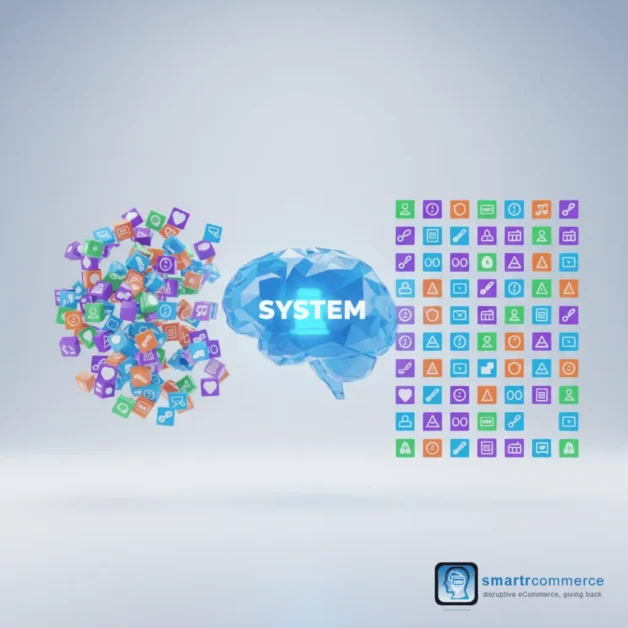
SmartrCommerce was not built to replace Shopify. It was built to solve the problems Shopify was never designed to handle. It approaches ecommerce as a system, not a storefront.
Instead of asking which app you need next, SmartrCommerce asks:
- How does money flow through your business?
- How do customers move across offers?
- How do tools talk to each other without friction?
SmartrCommerce Does Not Rely on App Stacking
Where Shopify relies on external apps, SmartrCommerce focuses on built in capability. That means fewer integrations, fewer monthly subscriptions, and fewer breaking points.
SmartrCommerce Is Built Around Business Logic Not Features
Shopify gives you options. SmartrCommerce gives you structure.
You’re not wondering which app talks to which tool or why your numbers don’t match. It treats commerce as an ecosystem, not a plugin playground.
Shopify App Marketplace vs SmartrCommerce: A Practical Comparison
When comparing the Shopify app marketplace to system driven platforms like SmartrCommerce, the differences become easier to see in practice.
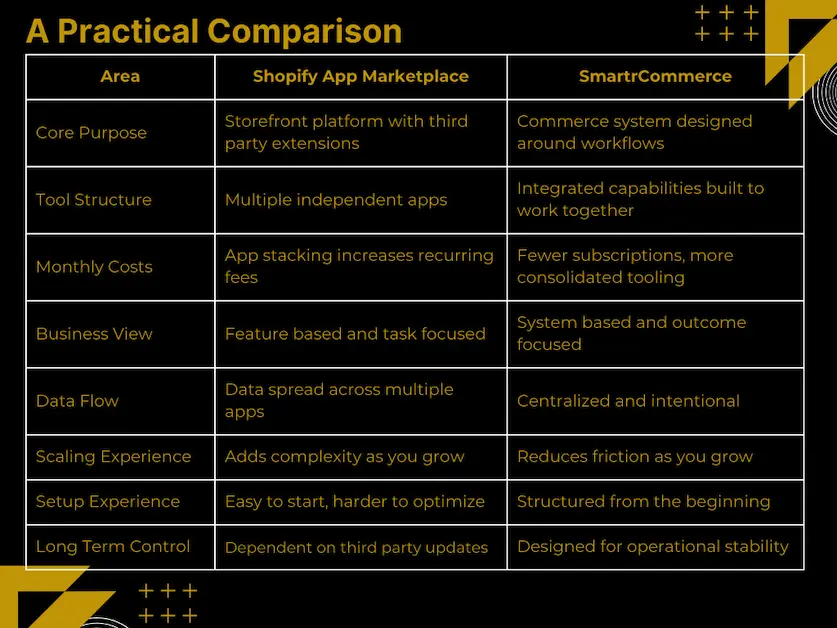
For many growing brands, this moment marks the shift from relying on the Shopify app marketplace to building a more intentional commerce infrastructure.
Why This Matters More Than Ever Right Now
In 2026, the ecommerce landscape is shifting toward intelligence over volume. Ads cost more, and attention is harder to earn. Brands relying heavily on a single platform face existential risk. What works now are businesses that:
- Understand their full system
- Control their data
- Reduce tool dependency
This Triple Whale industry report explains why platform diversification and “system over tool” thinking is critical in 2026.
Shopify and SmartrCommerce Can Coexist But Roles Matter
This is not an either or conversation. Shopify is still excellent for storefronts. SmartrCommerce is excellent for orchestration. Many businesses use Shopify as the front end and SmartrCommerce as the brain behind it. That combination creates leverage.
For a look at how retailers are managing the “total cost of ownership” between different platform models, see this Shopify Enterprise analysis.
The Real Question to Ask Before Adding Another Shopify App
Before you install your next app from the Shopify app marketplace, pause and ask:
Is this solving a business problem or just adding another tool to manage?
If it is the second one, it might be time to look at your system as a whole. That moment is usually where SmartrCommerce starts to make sense.
Not because it is louder, but because it was built for the phase where structure matters more than features.
Takeaway Moment
The Shopify app marketplace isn’t broken.
It simply isn’t designed to think in systems.
SmartrCommerce is.
That difference matters when you are no longer just launching a store, but operating a business. SmartrCommerce is built for clarity, cohesion, and long term growth so your systems support you instead of slowing you down.

Christi Spruill is a growing force behind the SmartrWomen movement with an unapologetically honest and loud voice teaching women about business, professional development, and personal growth. A Mom, sister, and Gigi she writes like she lives, with faith, grit and a lot of sarcasm to keep it real. Christi reminds women that even in the chaos, purpose still calls. Her message is simple, stay real, stay rooted, and keep rising, because your story matters.
Raw. Rooted. Rising. = Unstoppable Legacy